
Fortune Suraj Bhan Grande Floor Plans
Fortune Suraj Bhan Grande offers five RERA-approved floor-plan typologies across 3 BHK and 4 BHK configurations, ranging from 2,850 to 3,910 sqft. Every apartment is a four-side-open "hanging" floor plate with 11-foot slab-to-slab ceiling heights, private lift lobby access on higher floors, and no shared wall with more than one neighbouring apartment. Hallmark Altus is relevant when the floor-plan decision turns from square footage to storage, work-from-home use, bedroom privacy, and long-term family comfort.
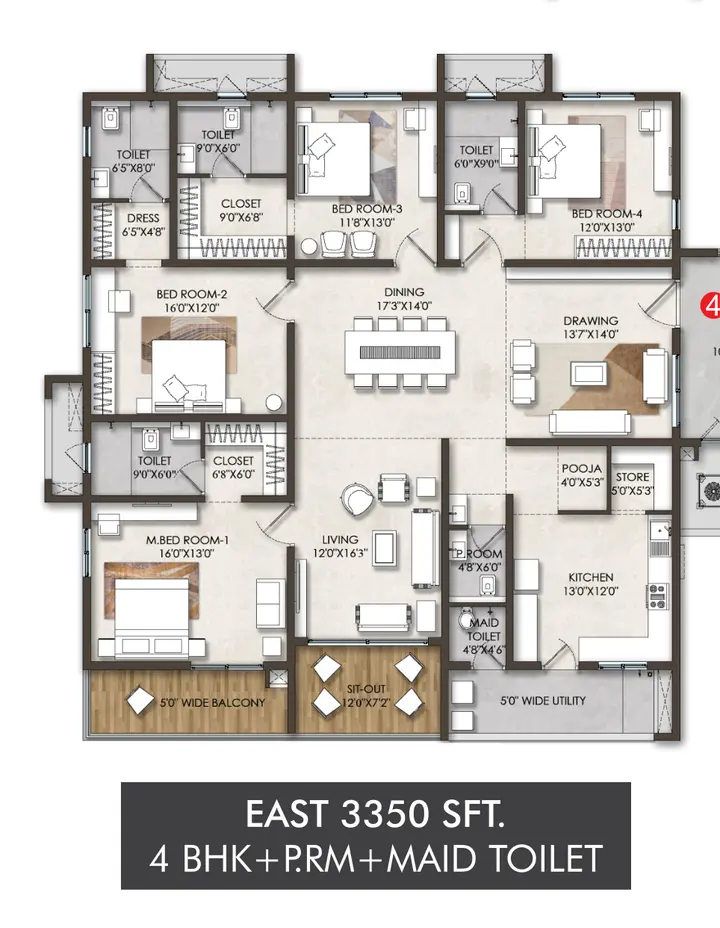

The five typologies at a glance
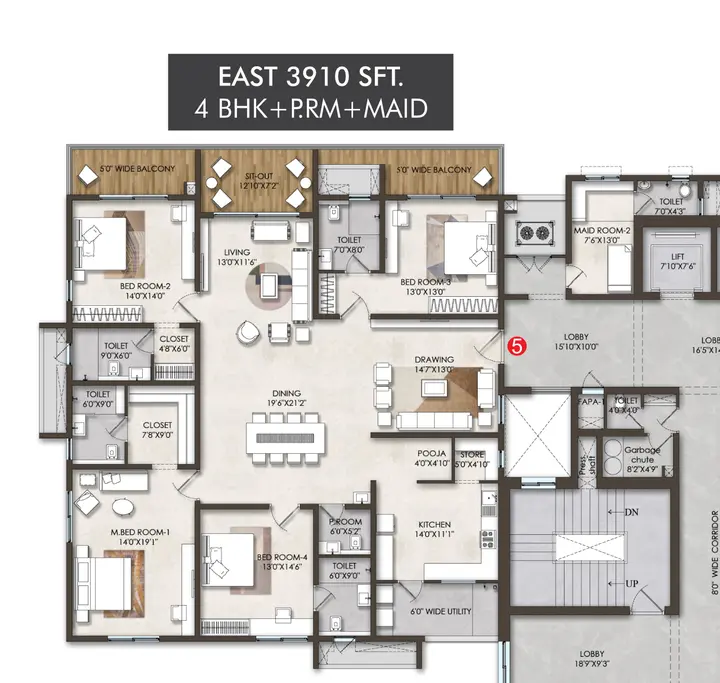
The floor-plan set is deliberately compact - five typologies covering all 1,350 units - rather than the dozen-plus variants some peer projects ship with. The reasoning is repeatability: each typology is tested, finalised and then repeated across the six towers, which is how the Mivan construction schedule stays predictable and the finish quality stays consistent across floors. Click any image below to see it full-screen.
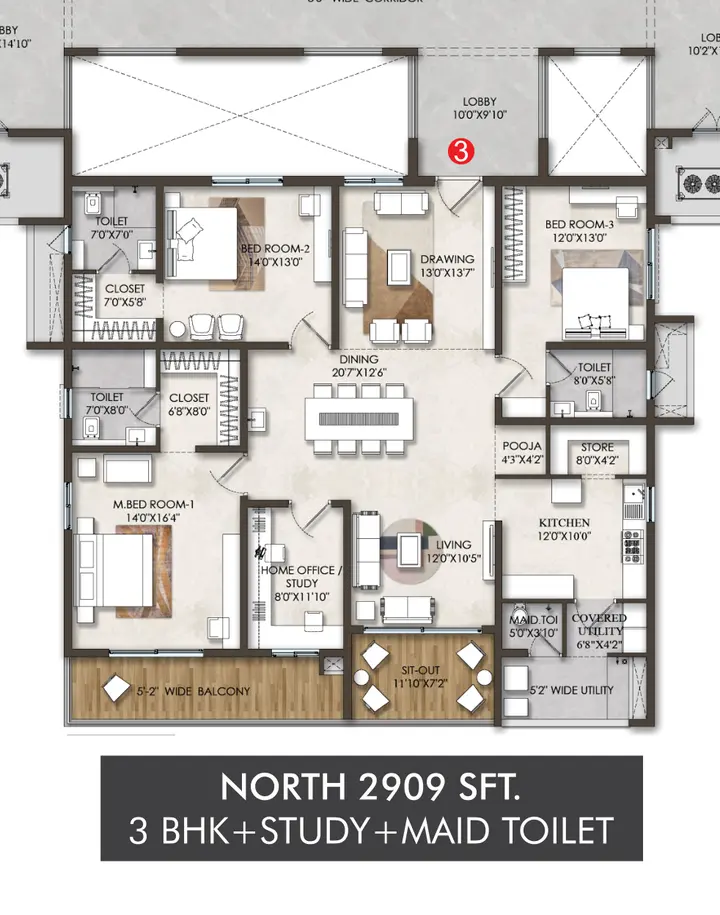
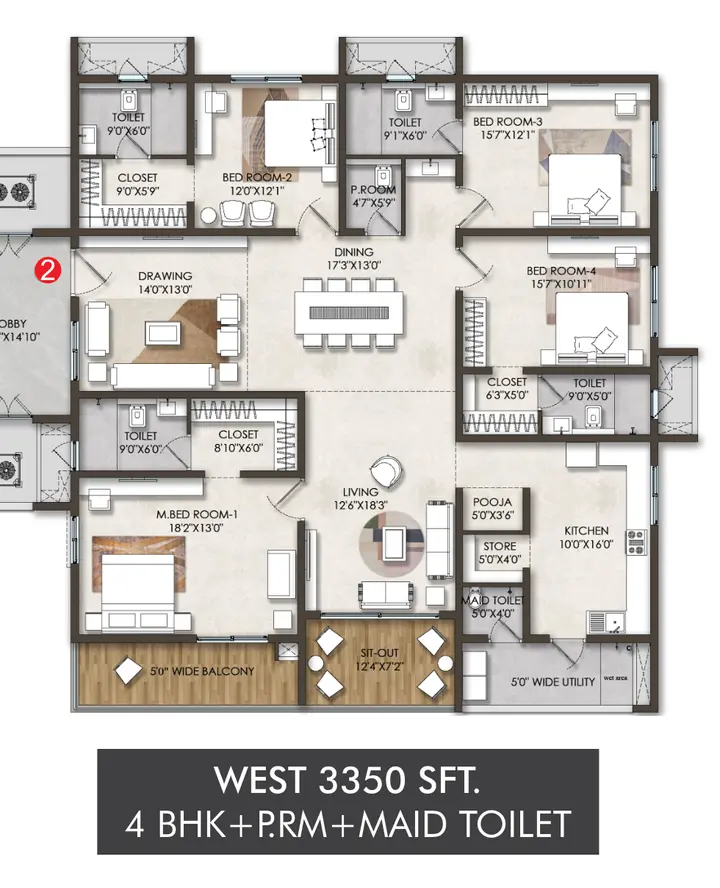
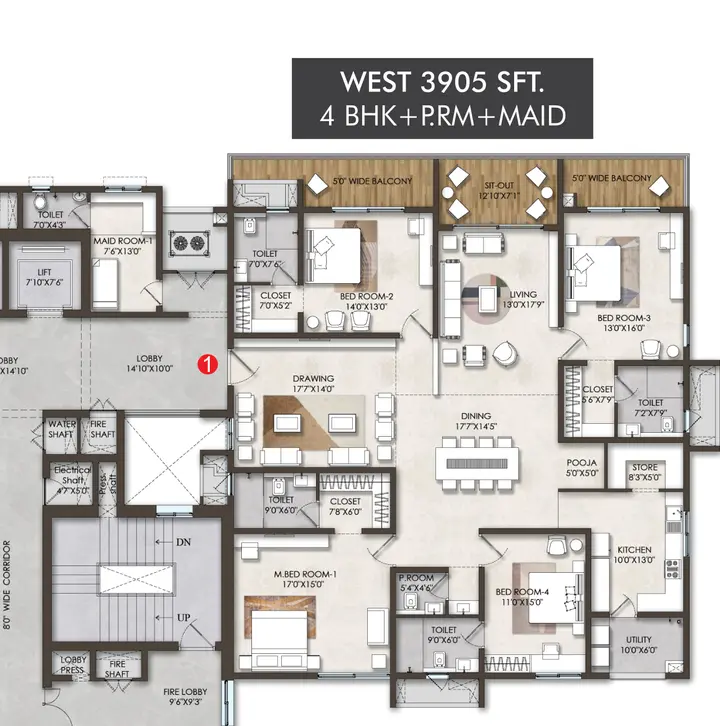
Unit mix and pricing anchors
The inventory split is weighted toward 4 BHK - approximately two-thirds of the 1,350 units are 4 BHK and the remaining third are 3 BHK. This is a deliberate positioning call by Sri Sreenivasa Infra: the Kokapet buyer profile at this price band is skewing larger in floor-plate size every year, driven by NRI returnees, multi-generational households and senior professionals upgrading from older Jubilee Hills plots. By weighting the mix toward 4 BHK, the project aligns with where the end-user demand is strongest, while the 3 BHK stock captures the investor and first-time ultra-luxury entrants.
Typology |
Super built-up |
Facing |
Starting price |
|---|---|---|---|
3 BHK | 2,909 sqft | North | ₹2.62 Cr |
4 BHK | 3,350 sqft | East | ₹3.04 Cr |
4 BHK | 3,350 sqft | West | ₹3.12 Cr |
4 BHK | 3,905 sqft | West | ₹3.54 Cr |
4 BHK | 3,910 sqft | East | ₹3.50 Cr |
Reading a Fortune Grande floor plan
Four-side-open planning is the single biggest design commitment in the project, and it changes how each plan reads. In a conventional apartment, you walk through the main door into a shared corridor-style foyer with the living room on one side and the bedroom wing running off the other. In a four-side-open plan, the entry opens directly into a private lift lobby (shared by only two apartments per floor on most typologies), and from there you step into an L-shaped living-dining-kitchen arrangement that wraps the two primary faces of the apartment. Bedrooms sit on the other two faces - each with its own independent ventilation wall, full-height external glazing, and no shared wall with another apartment's bedroom. The outcome is that every habitable room gets natural light from at least one external wall, not a light well or internal ventilation shaft.
The 11-foot slab-to-slab ceiling height translates to approximately 10'2" finished ceiling height after false-ceiling and services - roughly 18 inches taller than the standard 9'6" Hyderabad floor-plate, and meaningfully taller than the 9'0" that appears in many older Kokapet launches. This isn't just an aesthetic upgrade. Taller ceilings compound with the four-side cross-ventilation to make air conditioning dramatically more efficient - the lived experience is cooler apartments with lower electricity bills, and a sense of volumetric luxury that photographs translate poorly. You'll feel it on a site visit well before you notice it on a plan.
Carpet vs super built-up
RERA rules mandate disclosure of carpet area for each apartment, and the Fortune Grande RERA filing carries the carpet numbers alongside the super built-up figures used in marketing. The efficiency ratio (carpet ÷ super built-up) at Fortune Grande sits at approximately 62–65% depending on typology, which is at the efficient end of the ultra-luxury segment. The difference between super built-up and carpet is distributed across balconies, utility area, internal walls, elevator lobbies, stairwell shares and clubhouse-area loading - the standard composition for a high-rise development of this format. Balconies in particular are generous at Fortune Grande, reflecting the "hanging apartment" design language where external elevation articulation doubles as usable outdoor space for residents.
The full carpet-area breakdown by typology is part of the RERA-filed project document and is shared with serious buyers at site visit. When you're comparing Fortune Grande against a peer Kokapet launch, always compare carpet-to-carpet rather than super built-up-to-super built-up; loading factors vary between projects and can distort the per-square-foot comparison significantly. The pricing page explains the all-in cost calculation and how other charges (clubhouse, amenities, corpus, floor rise, PLC) build on top of the base price to arrive at the full purchase cost.
Which typology is right for you
For a two-adult or two-adult-plus-one-child household with periodic guests, the 3 BHK at 2,909 sqft is the right anchor. You get three en-suite bedrooms, a powder room, a large living-dining, a working kitchen with a utility, and one decent study-cum-media space - without paying for square footage that sits unused. For a three-bedroom-plus-full-study household or a family that genuinely cooks at scale, the 4 BHK at 3,350 sqft is the volume sweet spot; you gain the fourth bedroom (usually set up as guest or grandparents), a larger kitchen with provision for a separate pooja-cum-prep area, and a genuinely spacious living-dining.
The 4 BHK at 3,905/3,910 sqft is the premium play - it's the floor plate that unlocks the signature lake-view orientations on the western faces of Towers 5 and 6, and it includes a formal family room separate from the living-dining plus a dedicated home-office. For buyers coming from a 2,500+ sqft Jubilee Hills bungalow context, this is the typology that most closely replicates the lived volume they're used to, with the added benefit of the vertical view and the modern building infrastructure. The master-plan page shows which towers carry which typologies; the amenities page is relevant because larger floor plates benefit disproportionately from the clubhouse programming (the household uses more facilities).
Get high-res floor plans
Request the full high-resolution floor-plan PDFs including dimensioned plans, carpet-area breakdowns, and the apartment-view orientation diagrams for each tower.
Fortune Suraj Bhan Grande Floor Plans - Frequently Asked Questions
What floor plans does Fortune Suraj Bhan Grande offer?
The plan covers 3 BHK at 2,850–2,909 sqft and 4 BHK at 3,303–3,910 sqft across five live typologies. The full floor-plan pack and per-unit carpet areas are filed under the Telangana RERA registration.
What is the size of a 3 BHK at Fortune Suraj Bhan Grande?
Three-bedroom apartments span 2,850 to 2,909 sqft super built-up area. This is the primary product for the project and is positioned for senior professionals transitioning from older Jubilee Hills or Banjara Hills bungalow-society homes.
What is the size of a 4 BHK at Fortune Suraj Bhan Grande?
Four-bedroom apartments span 3,303 to 3,910 sqft super built-up area. The 4 BHK is reserved for multi-generational households and larger formats, with top-line floor plates running up to ₹3.54 Cr.
Are all apartments at Fortune Suraj Bhan Grande four-side-open?
Yes - every apartment in every typology is designed with external walls on all four sides, with no shared walls beyond one neighbour. Each habitable room receives natural light through this floor-plate language.
Are Fortune Suraj Bhan Grande apartments Vastu compliant?
Yes. Main entries, lift lobbies and apartment arrangements are designed for 100% Vastu compliance across all typologies. Layout drawings can be cross-checked at the site office during a model-apartment walk-through.
Why is there no 1 BHK or 2 BHK in the Fortune Suraj Bhan Grande mix?
The project deliberately restricts inventory to 3 and 4 BHK to avoid the diluted resident profile that 1 and 2 BHK stacks typically introduce. The choice is intended to protect resale values and rental yields for long-hold investors.