
Fortune Suraj Bhan Grande Master Plan
The Fortune Suraj Bhan Grande master plan arranges six B+G+45 towers around a 7.5-acre central landscape courtyard, keeping 75% of the 12-acre site as open space. A 1,00,000 sqft five-level clubhouse anchors the centre, with pedestrian paths, sports decks and landscape gardens wrapping outward to the tower bases. For another Hyderabad planning reference, Hallmark Altus helps keep attention on density, circulation, landscape depth, and the way residents will move through the community.
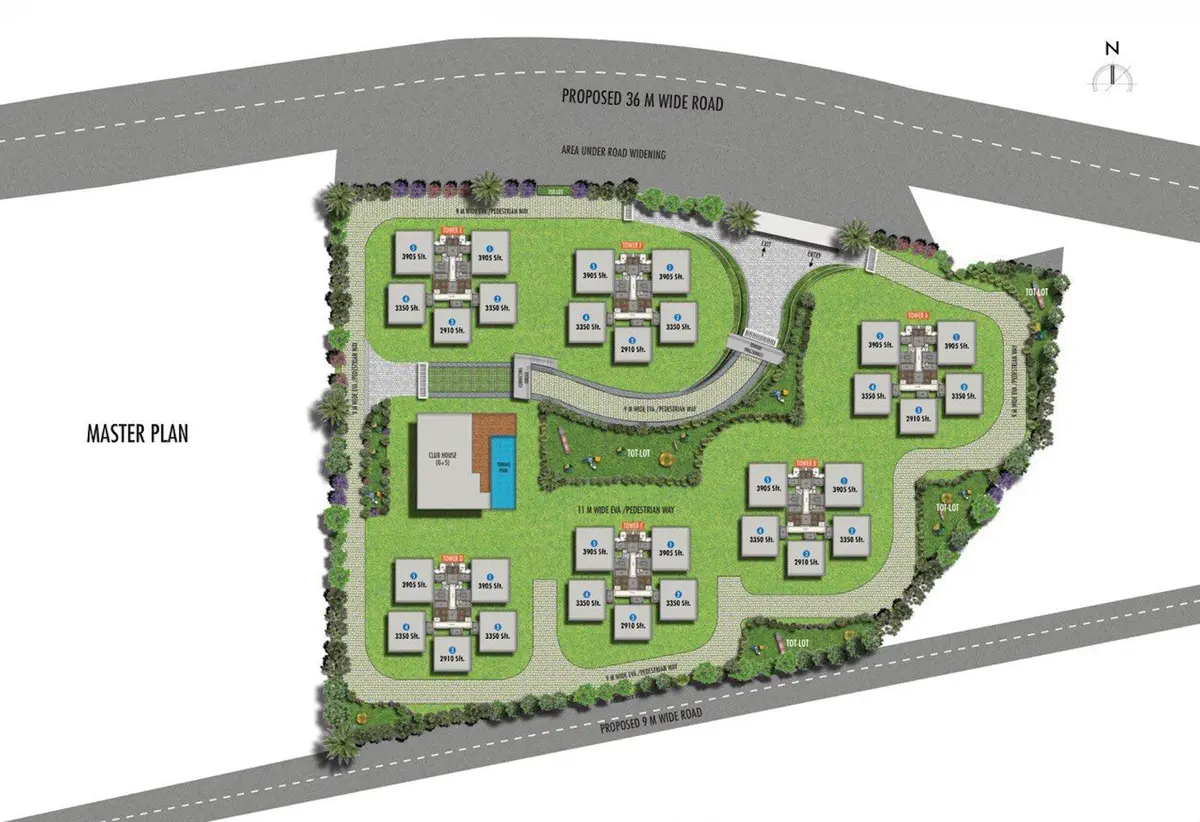

The layout logic
The six towers at Fortune Grande are placed along the site's outer edge in a loose ring, deliberately keeping the geometric centre of the 12-acre parcel free of built structure. This is an unusual choice in Hyderabad's current high-rise pattern - most peer projects place towers in a denser cluster to free up an access spine, because the land economics at ₹9,500+ per sqft of built-up area make ground coverage expensive to concede. Fortune Grande goes the other way. By pushing towers outward, the architects have carved a 7.5-acre continuous landscape plate at the centre, with the clubhouse at the true middle and the amenity programme radiating outward. The result is that every apartment has a view of green rather than a view of its neighbouring tower, which is the single biggest upgrade over typical Kokapet inventory.
The ring arrangement also resolves a common acoustic problem in vertical developments. With towers on the perimeter, the central courtyard acts as a sound buffer between tower faces - morning gym activity, pool sessions, kids' play and amphitheatre events do not bounce off one tower face into another. Internal vehicle movement is confined to a peripheral driveway loop that runs behind the towers on the outer edge, and all resident pedestrian movement stays inside the central green zone. Service access is separated again through a dedicated utility spine at the southern boundary, which is how dense-schedule deliveries can happen without crossing the amenity plate.
Zoning the 12 acres
The site is organised into six zones, each with a specific function. The six tower footprints occupy roughly 25% of the total ground area, which is the 75% open-space number reported in marketing collateral - this is calculated by the standard HMDA method of total plot area minus built footprint at ground level. Of the remaining 75%, the 7.5-acre central landscape occupies roughly 62%, distributed across a main lawn, wellness gardens, a kids' play plaza, senior citizen lounges and a tree-lane avenue that frames the approach to the clubhouse. The clubhouse itself is ground + four levels, with a footprint that reads compact against the lawn scale despite the 1,00,000 sqft interior area. The remaining open area is split between vehicle driveway loop (roughly 8%), amenity hardscape including tennis, basketball and badminton courts (roughly 3%), and landscape buffers against the site boundary (roughly 2%).
Tower numbering runs clockwise from the north-east corner. Towers 1 and 2 face the approach road and carry the primary arrival drop-off; Towers 3 and 4 sit along the eastern boundary with longer views across the Neopolis zone; Towers 5 and 6 form the southern and western edge with clearer views toward Gandipet Lake. The specific tower-by-tower view profile matters for pricing - west-facing 4 BHK floor plates with lake views are the most premium inventory in the launch, while east-facing 3 BHK units on lower floors carry the anchor entry pricing of the project.
The central courtyard
The 7.5-acre central landscape is the project's signature. It's designed as a sequence of rooms rather than a single lawn - arrival garden at the entry, then a formal axis leading to the clubhouse, then wellness gardens flanking the east and west sides, a full sports deck on the south edge, and a cluster of children's play zones and reading gardens tucked into the north side. A continuous pedestrian path runs through all zones at a constant grade, so residents can move the full length of the central plate without crossing driveways or hardscape. The planting palette uses native and drought-adapted species to reduce long-term maintenance water use, with shaded tree cover concentrated along pedestrian routes.
A feature that deserves specific attention: the central courtyard sits roughly two metres above the main driveway level, which provides visual privacy from the perimeter road. You walk up a shallow ramp from the main entry drop-off into the raised landscape plate, and from that level the driveway and vehicle movement essentially disappear from the resident's experience. This landscape-over-driveway arrangement is a standard move in well-designed high-density projects globally, but it is still rare in Hyderabad. Combined with the Mivan construction on the towers and the podium treatment on the clubhouse, it signals architectural intent well above the local norm for Kokapet's launch cohort.
The clubhouse at the centre
The 1,00,000 sqft clubhouse is spread across five levels, benchmarked against five-star hotel club-floor programming rather than the typical residential community centre. The ground level holds arrival lobby, concierge, reception, crèche and the main banquet hall that opens onto the central lawn. Level 1 is wellness-focused - a full gym, separate yoga and aerobics studios, a spa and salon wing, and physiotherapy rooms. Level 2 is social - co-working lounges, a business centre, meeting rooms, a library, a cigar lounge and dining options. Level 3 is entertainment - a private screening room, indoor sports (squash, table tennis, snooker, cards room), a gaming lounge for older children, and a creche extension for younger ones. Level 4 is the terrace experience - the infinity-edge pool, a pool deck, a sky lounge with full views across the Neopolis horizon, and a landscaped sundeck.
Programming separation is important in a development with 1,350 households. Morning-use facilities (gym, yoga, pool, concierge, kids' play) are designed to handle the 7–9 am peak without queue buildup, and evening-use facilities (banquet, screening room, sports, lounges) are sized for the post-7 pm cycle. The clubhouse's peak-hour capacity is planned at approximately 15–18% of total resident count, which sits at the comfortable end of the global luxury-residential norm (typical figures run 10–12%). For a long-hold buyer, the implication is that Fortune Grande's amenity programme should not feel stretched at full occupancy the way some smaller Kokapet launches will.
Construction technology and structural logic
All six towers are being built using Mivan aluminium formwork. This technology uses precision-engineered aluminium panels to pour each floor as a single monolithic concrete structure, producing wall and slab surfaces accurate to millimetre tolerances and eliminating the plaster-and-putty finishing layer that produces cracks in conventional brick-and-plaster construction. Mivan construction is standard for ultra-luxury high-rises in Mumbai and Gurgaon but is still transitioning from niche to mainstream in Hyderabad's market. For Fortune Grande, the structural benefit is cleaner lines, fewer long-term cracks, better thermal performance, and - critically - a faster construction cycle that supports the December 2029 handover target across all 1,350 units in a coordinated schedule.
Foundation is raft-and-pile to handle the 45-storey tower loads and the local soil bearing characteristics. The basement level runs continuously across the six-tower footprint, functioning as a combined parking and services floor, which is how the project delivers its 1,350 covered car spaces plus visitor parking without compromising ground-level landscape. Structural design has been tested for wind loading appropriate to the 150+ metre tower heights, and the internal layouts have been checked for seismic performance - although Hyderabad is in a low-seismic zone, the ultra-luxury product class typically over-specifies on this dimension as insurance against the long-term hold horizon that buyers plan for.
What this means for the buying decision
The master-plan choices compound into three concrete buyer-facing outcomes. First, view quality is materially better than at the same-priced peer project on a smaller parcel - you're paying for land-bank-per-unit as much as you're paying for the apartment itself. Second, amenity headroom is larger, which matters more as residents age into the property and start using the wellness and social programming at higher frequencies. Third, resale positioning is stronger because the master plan protects against the "crowding-in" risk - once the project is fully built, adjacent parcels cannot change your open-space ratio. If you want to see how the 5 live floor-plan typologies fit onto this tower layout, the floor plans page has them drawn; the amenities page lists what the clubhouse and courtyard actually contain; and the pricing page translates the master-plan advantages into the floor-rise and preferential-location charges you'll see on the cost sheet.
See the full master plan
Get the complete tower-by-tower master plan with apartment-count distribution, amenity legend, and view-angle diagrams. Sent directly to your email within two working hours.
Fortune Suraj Bhan Grande Master Plan - Frequently Asked Questions
What is the master-plan footprint of Fortune Suraj Bhan Grande?
The project occupies a single 12-acre consolidated parcel with six B+G+45 towers and 1,350 apartments. Roughly 7.5 acres are reserved as a central courtyard, with shared amenities placed at the centre of the site rather than at tower bases.
How are towers arranged in the Fortune Suraj Bhan Grande master plan?
The six B+G+45 towers are positioned around a central courtyard so each apartment can be designed four-side-open. Inter-tower spacing keeps shared walls to at most one neighbour, with cross-ventilation across every habitable room.
What share of the Fortune Suraj Bhan Grande site is open space?
Open-space commitment is roughly 75% across the 12-acre plate, well above the 55–65% typical for Kokapet launches on smaller 4–7 acre parcels. The larger plate is what allows a genuine central courtyard rather than token landscape strips.
Where does the clubhouse sit in the Fortune Suraj Bhan Grande master plan?
The 1,00,000 sqft clubhouse sits at the centre of the site, deliberately distanced from tower bases so early-morning users don't disturb residents on lower floors. It spans five levels - ground plus four - and anchors the central courtyard programming.
What construction technology is used across the Fortune Suraj Bhan Grande master plan?
All six towers use Mivan aluminium formwork, producing monolithic concrete structures with millimetre-accurate wall and slab tolerances and no plaster-and-putty finishing layer. The structural system is a raft-and-pile foundation designed for 45-storey tower loads with continuous basement parking across the six-tower footprint.
Is the Fortune Suraj Bhan Grande build phased or single-launch?
The 12-acre parcel is being delivered as a single consolidated build rather than a phased township - superstructure rises across all six towers in a coordinated sequence. This avoids the multi-year staggered launches that plague some comparable Kokapet projects.